“What type of fence separates us from the Dragons?”, I asked in several different ways over the course of several days. I was emailing back and forth with my guide who was not very proficient in English, and we weren’t communicating very well. I wanted to make sure that I would be close enough to be able to see them well. I didn’t want to spend the time and effort to travel that far and then view them only from a distance.
Well, my worry was misplaced. I should have been worried that there is *nothing* separating me from the Dragons. The only thing protecting me was a ranger who accompanied me around the island (and who looked to be about 14 years old) carrying a forked stick. The Dragons are free to roam anywhere on the island, including up to and sometimes even inside the huts of the park rangers.
Komodo Dragons
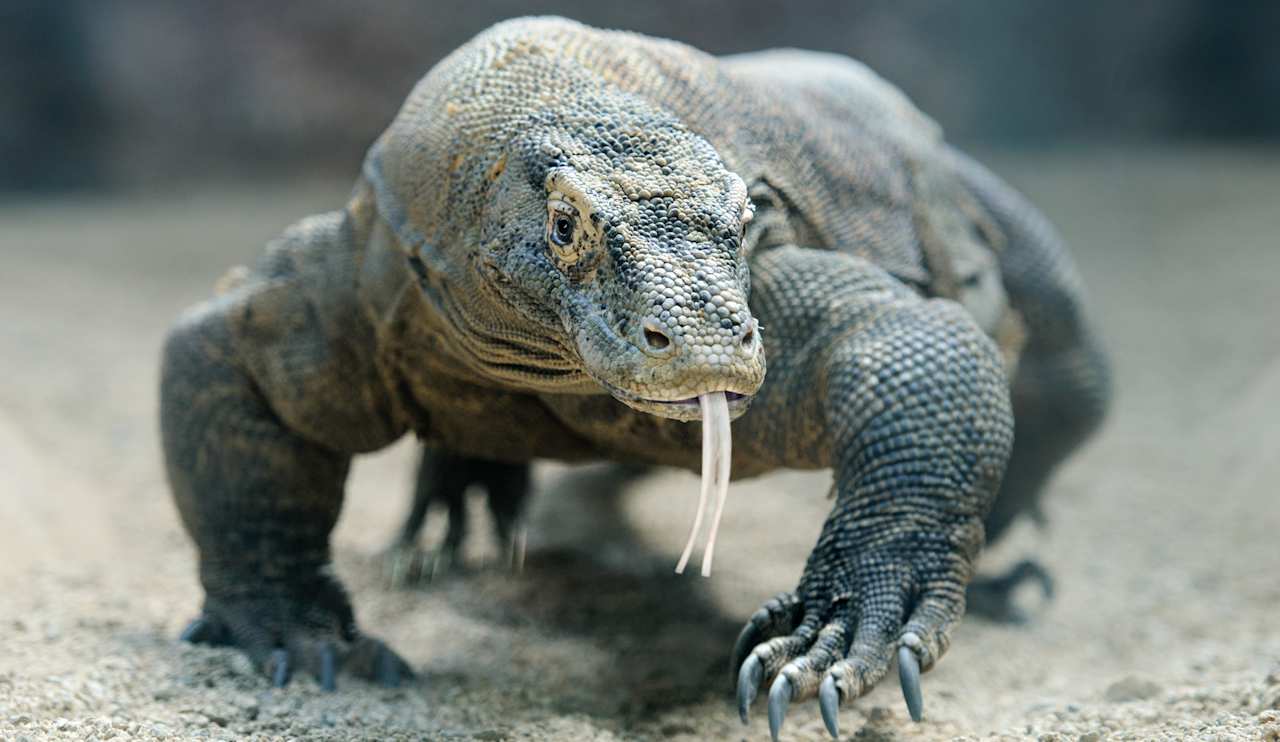
A branch of the family of monitor lizards, Komodo Dragons (or Varanus Komodoensis) have existed as a species for about 5 million years. Their genus goes back another 35 million. They are found exclusively on a few islands in the Indonesian archipelago. Their main source of food is deer and water buffalo, and slow tourists (kidding!). Some things to know:
I booked a boat for myself, and when I arrived very early in the morning, there was nobody else there. It was worth the extra cost. If you go with a group, book the boat early, especially in the high season.
If you are there by yourself, or in a small group, you and your group can decide how long to make the tour.
Bring a hat and sun screen. It can get hot, and you will probably want to spend several hours on the island.
Be extra careful if you have any blood on you (open scrapes, etc.). Dragons can smell the blood from miles away.
A running Komodo dragon tops out at about 12 miles per hour in short bursts.
I arrived by boat to a small hut with an attached dock on Rinca Island. There was nobody there, so the captain tied up while I jumped off. The hut had a sign welcoming us to Loh Buaya Komodo National Park, and another with cartoons warning us not to let the dragons bite us (does this need to be said?) There was nobody there to greet us… very ominous… so we walked up through a small gate, following a worn path. Still not knowing what to expect, it was startling to look across an open expanse and see dragons, unrestrained, mostly plopped on the ground sunning themselves, but occasionally meandering slowly right out in the open. The path led us to a small group of wooden, thatch-roofed huts, one of which was labeled “TAMAN NASIONAL KOMODO”. That’s where we met the rangers and purchased our tickets.
The “tour” is a walk around the island. There are many different trails, and the ranger I was with seemed content to let me choose our path. I thought I was very focused on them, but more often than not my guide pointed out dragons which I had failed to notice. A motionless dragon blends in very will with its surroundings. During the late morning hours, they spend most of the time relaxing in the sun, warming their bodies the only way they can. We came across numerous skulls and bones of past dragon meals, mostly placed in trees on display by the rangers. I had read that deer was their favorite meal, but on my tour the water buffalo skulls outnumbered them at least two to one. I was surprised to see a monkey skull, since I was told that the plentiful, but agile monkeys rarely make it on the menu.
When we arrived back at the ranger station, the dragons were getting a little more active, and several of them were mulling around the huts. This was obviously a common occurrence since this caused no alarm to the rangers. They just shoe them away with their forked stick, if the dragons become a nuisance.
If you are nervous, ask the ranger for a forked stick of your own before you set off on the trail. Spend a minute or two, stabbing the “V” out away from yourself to prepare for the attack that probably will not come.
Why go?
If you don’t like lizards, then you should skip this trip. But if interacting with large reptiles intrigues you, then you won’t find a better place.
This is not a zoo. If you visit, you will be walking among the dragons. How close you get is up to you.
What you need to know:
Unlike dragons of lore, they do no breath fire; but their venomous saliva may feel that way to victims.
The venom in their saliva keeps the blood of the victim from clotting, so they bleed out quickly.
Once the dragon has bitten the prey, there is very little hope of escape. Even if the prey is able to get away, the 60-some strains of bacteria that live in the dragon’s mouth will infect the prey and slowly do it in. The dragon merely has to stalk the wounded animal and bide it’s time before dinner.
Dragons can smell the scent of a rotting corpse from miles away.
This sense of smell is their main food detector, since they have fairly poor vision and hearing. Their forked tongue samples the air, much the same way a snake does.
The locals consider the dragons to be related to them, according to folk lore, so they protect them.
The first known reference to them is from ancient maps of the region, which bore the words “Here be dragons”.
Komodo National Park – "Just come a little closer..." . Location: Komodo/Rinca Island, Indonesia . Actually, he`s probably just thinking "Stop bothering me. I`m trying to nap". These dragons don`t have to try hard to catch dinner. You`ll want to catch the details in my travel blog. . Head to the link in my profile for more details at my travel blog: @mytravels.hdf . Picture taken: 09/2010 . #Komodo #Rinca #KomodoDragon #Indonesia #KomodoIsland #RincaIsland #KomodoDragons #Dragon #Dragons #HereBeDragons #TamanNasionalKomodo #KomodoNationalPark #KomodoNationalParkIndonesia #WorldHeritage #WorldHeritageSite #unescoworldheritagesite #waterbuffalo...
Komodo National Park – The dinner menu . Location: Komodo National Park - Rinca Island, Indonesia . No leftovers here. These bones were picked clean. You`ll want to catch the details in my travel blog. . Head to the link in my profile for more details at my travel blog: @mytravels.hdf . Picture taken: 09/2010 . #Komodo #Rinca #KomodoDragon #Indonesia #KomodoIsland #RincaIsland #KomodoDragons #Dragon #Dragons #HereBeDragons #TamanNasionalKomodo #KomodoNationalPark #KomodoNationalPark,Indonesia #WorldHeritage #WorldHeritageSite #unescoworldheritagesite #waterbuffalo...
Labuan Bajo - A view of the harbor . Location: Labuan Bajo, Indonesia . A view of the harbor before my early morning boat ride to Komodo National Park. You`ll want to catch the details in my travel blog. . Head to the link in my profile for more details at my travel blog: @mytravels.hdf . Picture taken: 09/2010 . #Komodo #Rinca #KomodoDragon #Indonesia #KomodoIsland #RincaIsland #KomodoDragons #Dragon #Dragons #HereBeDragons #TamanNasionalKomodo #KomodoNationalPark #KomodoNationalParkIndonesia #LabuanBajo #Badjo #WorldHeritage #WorldHeritageSite #unescoworldheritagesite...
Komodo National Park – Trying to blend in . Location: Komodo/Rinca Island, Indonesia . Not that these legendary creatures have to use the element of surprise... The abundance of bacteria in their saliva is more than enough to give them the upper hand. You`ll want to catch the details in my travel blog. . Head to the link in my profile for more details at my travel blog: @mytravels.hdf . Picture taken: 09/2010 . #Komodo #Rinca #KomodoDragon #Indonesia #KomodoIsland #RincaIsland #KomodoDragons #Dragon #Dragons #HereBeDragons #TamanNasionalKomodo #KomodoNationalPark #KomodoNationalPark,Indonesia #WorldHeritage #WorldHeritageSite #unescoworldheritagesite #waterbuffalo...
Komodo National Park – A dragon right next to a ranger hut . Location: Komodo/Rinca Island, Indonesia . These dragons roam free on the island. Only if they become a nusance or actually enter the ranger huts do the rangers shoo them away. . Head to the link in my profile for more details at my travel blog: @mytravels.hdf . Picture taken: 09/2010 . #Komodo #Rinca #KomodoDragon #Indonesia #KomodoIsland #RincaIsland #KomodoDragons #Dragon #Dragons #HereBeDragons #TamanNasionalKomodo #KomodoNationalPark #KomodoNationalPark,Indonesia #WorldHeritage #WorldHeritageSite #unescoworldheritagesite #waterbuffalo...
Komodo National Park – A water buffalo *AFTER* . Location: Komodo/Rinca Island, Indonesia . OK... quite a bit after. Water buffalo are one of the popular meals of the Komodo Dragon. . Head to the link in my profile for more details at my travel blog: @mytravels.hdf . Picture taken: 09/2010 . #Komodo #Rinca #KomodoDragon #Indonesia #KomodoIsland #RincaIsland #KomodoDragons #Dragon #Dragons #HereBeDragons #TamanNasionalKomodo #KomodoNationalPark #KomodoNationalParkIndonesia #WorldHeritage #WorldHeritageSite #unescoworldheritagesite #waterbuffalo...
Komodo National Park – A water buffalo *BEFORE* . Location: Komodo/Rinca Island, Indonesia . One of the popular meals of the Komodo Dragon. . Head to the link in my profile for more details at my travel blog: @mytravels.hdf . Picture taken: 09/2010 . #Komodo #Rinca #KomodoDragon #Indonesia #KomodoIsland #RincaIsland #KomodoDragons #Dragon #Dragons #HereBeDragons #TamanNasionalKomodo #KomodoNationalPark #KomodoNationalPark,Indonesia #WorldHeritage #WorldHeritageSite #unescoworldheritagesite #waterbuffalo...
Komodo National Park – A World Heritage Site . Location: Komodo/Rinca Island, Indonesia . Apparently, it used to be "THE" World Heritage Site... now it`s just one of many. 🙂 . Head to the link in my profile for more details at my travel blog: @mytravels.hdf . Picture taken: 09/2010 . #Komodo #Rinca #KomodoDragon #Indonesia #KomodoIsland #RincaIsland #KomodoDragons #Dragon #Dragons #HereBeDragons #TamanNasionalKomodo #KomodoNationalPark #KomodoNationalPark,Indonesia #WorldHeritage #worldheritagesite #unescoworldheritage #unescoworldheritagesite...
Komodo National Park – Here be Dragons! . Location: Komodo/Rinca Island, Indonesia . Today`s answer to the dragons of yore. Grab your courage and a long, forked stick (?) and head to only place on earth where these legendary creatures roam. Are they in cages? You`ll want to catch the details in my travel blog. . Head to the link in my profile for more details at my travel blog: @mytravels.hdf . Picture taken: 09/2010 . #Komodo #Rinca #KomodoDragon #Indonesia #KomodoIsland #RincaIsland #KomodoDragons #Dragon #Dragons #HereBeDragons #TamanNasionalKomodo #KomodoNationalPark #KomodoNationalParkIndonesia...
Komodo National Park – Here be Dragons! . Location: Komodo/Rinca Island, Indonesia . Today`s answer to the dragons of yore. Grab your courage and a long, forked stick (?) and head to only place on earth where these legendary creatures roam. Are they in cages? You`ll want to catch the details in my travel blog. . Head to the link in my profile for more details at my travel blog: @mytravels.hdf . Picture taken: 09/2010 . #Komodo #Rinca #KomodoDragon #Indonesia #KomodoIsland #RincaIsland #KomodoDragons #Dragon #Dragons #HereBeDragons #TamanNasionalKomodo #KomodoNationalPark #KomodoNationalParkIndonesia #komodoislands...




 Why go?
 What you need to know: