Remoteness
Alaska is truly one of the more unique spots in the United States. It also is one of the most remote, with the lowest population density of the country. In 2010, if every man woman and child in the State were given an equal share of land, each would be sitting on almost a square mile of land. Compare that with New York State, where 413 people would
be sharing each square mile. With a little over 1,000 miles of highways covering it 663,300 square miles, much of Alaska’s wilderness is untouched because it is so inaccessible.
History
Alaska was part of the Bering land bridge which allowed paleolithic man to cross over from Asia around 14K BC. The separation of the two continents occured millennia ago geographically, but only 150 years ago politically, when the U.S. purchased the territory from Russia in 1867. Though the decision to purchase Alaska for $7.2 was derided at the time as (Secretary of State William) Seward’s Folly, or Seward’s Icebox, the opposition subsided 30 years later when gold was discovered.
Two “different” Alaska experiences
Not all of what Alaska has to offer can be experienced in one trip. Not just because of it’s vastness, but because there are “two” Alaska’s separated by the time of year and a layer of snow. To see both, one has to travel there twice; once to see the beauty of the exposed nature, and once to experience it’s beauty shrouded in snow and silence.
For New Years’ 2010, I traveled to Alaska to experience the Artic Circle it all of it’s chilly beauty. I coordinated my trip through the Northern Alaska Tour Company, who handled all of the details. The trip included round-trip arrangements from Fairbanks up to Coldfoot, a refueling point on the Dalton Highway on the way to Purdue Bay. The trip was booked to fly one way and drive the other, but unfortunately, mother nature had other plans and the weather required us to drive both ways. Fortunately, mother nature made up for it with two nights of front row seats to her spectacular Northern Light show.
Northern Lights
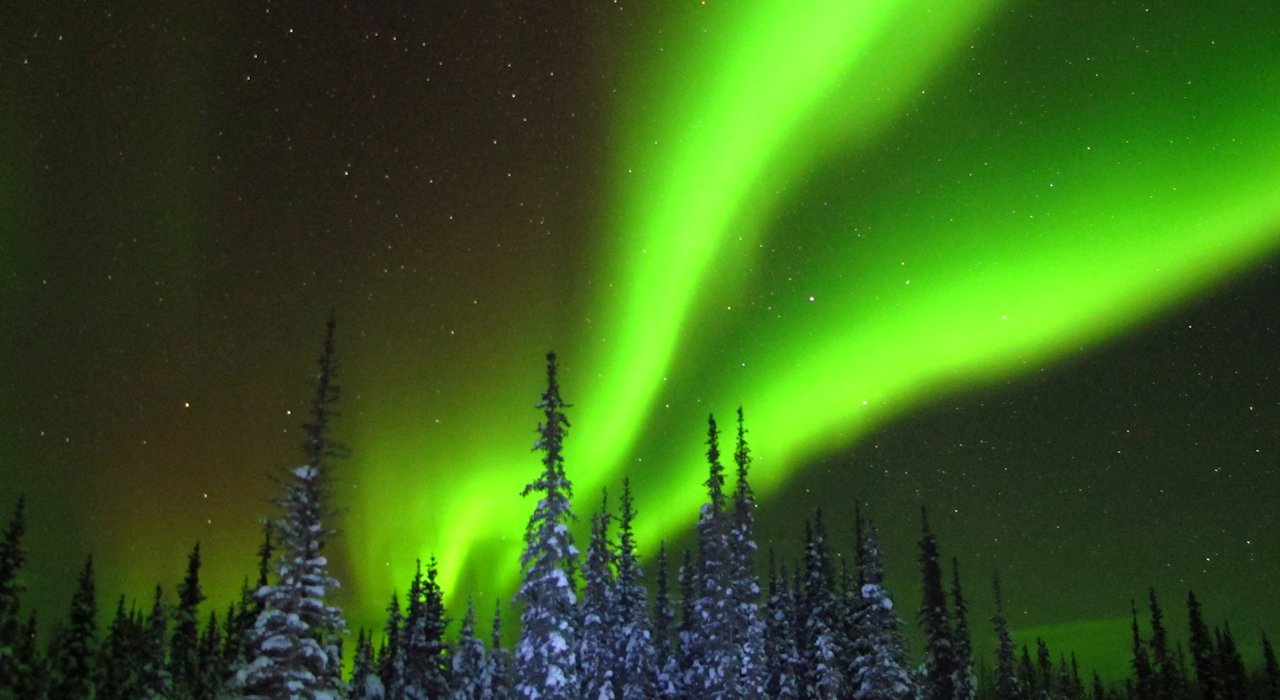
The Aurora Borealis is a remarkable display of dancing lights in the sky caused by disturbances of solar wind in the magnetosphere. Pictures don’t do it justice, as the lights “dance” across the sky, changing patterns and colors as they streak across the heavens.
 If you are interested in seeing the Aurora, then you will want to check one or more of the websites that try to predict them, including:
 Why go?
- Alaska in the winter is a totally different experience than in the summer. The wilderness is blanketed in a cover of snow giving the natural features a solemn look and dampening most noises to create an eerie silence.
- The Northern Lights are an almost indescribably experience. Pictures do not do them justice, any more than a photograph of Fred Astaire could try to demonstrate the experience of watching him dance.
 What you need to know:
- Coldfoot is literally a truck stop. Accomodations are rudamentary, but warm and clean. I stayed for just three nights. Much more than that would have been tiresome; especially if you don’t luck out with the Northern Lights.
- Accomodations are at the Slate Creek Inn, made up of trailers used to house workers who traveled to Alaska to build the pipeline. Though they’ve been refurbished and redecorated, they’re still rustic.
- The Northern Lights are not predictable. Sometimes they show, sometimes they don’t.
- Weather in general in Alaska is not predictable. Change happens, and you have to be prepared for it. We were not able to fly either way to Coldfoot, and instead had to drive six hours each way. However, this gave us the opportunity to experience the Dalton Highway during both daylight and nighttime.
- The Dalton Highway is mainly a two lane commuting route for trucks. Due to their size, they have the right of way.
- There is not much to do in Coldfoot except wait for the evening and hope for lights. Our tour included an evening with a local trapper, who invited us into his home and shared his knowledge. I was expecting it to be a “throw away” experience, but was pleasently surprised to find it entertaining and enlightening.
- Bring an appropriate camera. I purchased a Canon camera before coming on this trip specifically because it had a long exposure settings. This blurs the image a bit, but allows for enough light to enter to capture the Northern Lights.
- Bring a flashlight. You will need it to get back and forth to your accomodations in Coldfoot, and I also used it to light up some pine trees in the foreground while using the 15 second exposure on my camera on the Northern Lights.
- Make sure to stop off where the Dalton Highway crosses the Arctic Circle, for a great picture opportunity.
- Coldfoot is still far enough south that it does get some daylight, even in the middle of winter. For a couple of hours during the middle of the day, expect to see some sun as the light reflects above the horizon. Traveling further north, you would receive no daylight at all, only civil twilight.
Alaska - Oncoming truck
.
Coldfoot
Location: Mile 175 on the Dalton Highway
.
The beacon of light is the headlights of an oncoming truck driving on the Dalton Highway as the Northern Lights dance above.
.
Head to the link in my profile for more details: @mytravels.hdf
.
Picture taken: 12/2010
.
#Alaska #Coldfoot #NorthernLights #AuroraBorealis #Aurora #ArcticCircle #AlaskaInWinter #MyTravels.hdf.net #DaltonHighway #ColdfootAlaska #NewYears #oncoming
...
Alaska - "Daylight" during the dark winter months
.
Location: Dalton Highway
.
This picture looked to me like a group of people, covered in snow, lumbering on toward a distant goal.
The further north you travel, the less daylight you will get during the winter months. These pictures show some of the scenery and wildlife as seen during the limited light in the Arctic Circle at New Years.
Barrow, Alaska, the northern most point (accessible only by plane), by contrast, receives only civil twilight for two months each year.
.
Head to the link in my profile for more details: @mytravels.hdf
.
Picture taken: 12/2010
.
#Alaska #Coldfoot #ArcticCircle #DaltonHighway #ColdfootAlaska #AlaskaInWinter #NorthernAlaskaTourCompany #MyTravels.hdf.net #AlaskaHighway #civiltwilight
...
Alaska - "Daylight" during the dark winter months
.
Location: Dalton Highway
.
The further north you travel, the less daylight you will get during the winter months. These pictures show some of the scenery and wildlife as seen during the limited light in the Arctic Circle at New Years.
Barrow, Alaska, the northern most point (accessible only by plane), by contrast, receives only civil twilight for two months each year.
.
Head to the link in my profile for more details: @mytravels.hdf
.
Picture taken: 12/2010
.
#Alaska #Coldfoot #ArcticCircle #DaltonHighway #ColdfootAlaska #AlaskaInWinter #NorthernAlaskaTourCompany #MyTravels.hdf.net #AlaskaHighway #civiltwilight
...
Alaska - The Alaskan Pipeline
.
Dalton Highway
Location: Mile 175 on the Dalton Highway
.
A section of the Trans-Alaska pipeline system which flows crude-oil from Prudhoe Bay to Valdez, Alaska. It runs next to, and occasionally crosses over the Dalton Highway.
.
Head to the link in my profile for more details: @mytravels.hdf
.
Picture taken: 12/2010
.
#Alaska #Coldfoot #NorthernLights #AuroraBorealis #Aurora #ArcticCircle #AlaskaInWinter #MyTravels.hdf.net #DaltonHighway #alaskapipeline #transalaskapipeline
...
Alaska - Northern Lights
.
Coldfoot
Location: Mile 175 on the Dalton Highway
.
A serene and almost other-worldly picture showing the northern lights illuminating the horizon over the Dalton Highway around Coldfoot Alaska.
.
Head to the link in my profile for more details: @mytravels.hdf
.
Picture taken: 12/2010
.
#Alaska #Coldfoot #NorthernLights #AuroraBorealis #Aurora #ArcticCircle #AlaskaInWinter #MyTravels.hdf.net #DaltonHighway #ColdfootAlaska #NewYears
...
Alaska - Northern Lights and pine trees
.
Coldfoot
Location: Mile 175 on the Dalton Highway
.
I set my camera to 15 second exposures and waved a flashlight against the foreground pinetrees to light them as the Aurora Borealis whirled above. .
Head to the link in my profile for more details: @mytravels.hdf
.
Picture taken: 12/2010
.
#Alaska #Coldfoot #NorthernLights #AuroraBorealis #Aurora #ArcticCircle #AlaskaInWinter #MyTravels.hdf.net #DaltonHighway #ColdfootAlaska #NightPhotography
...
Alaska - "Daylight" during the dark winter months
.
Location: Dalton Highway
.
The further north you travel, the less daylight you will get during the winter months. These pictures show some of the scenery and wildlife as seen during the limited light in the Arctic Circle at New Years.
Barrow, Alaska, the northern most point (accessible only by plane), by contrast, receives only civil twilight for two months each year.
.
Head to the link in my profile for more details: @mytravels.hdf
.
Picture taken: 12/2010
.
#Alaska #Coldfoot #ArcticCircle #DaltonHighway #ColdfootAlaska #AlaskaInWinter #NorthernAlaskaTourCompany #MyTravels.hdf.net #AlaskaHighway #civiltwilight
...
Alaska - "Daylight" during the dark winter months
.
Location: Dalton Highway
.
The further north you travel, the less daylight you will get during the winter months. These pictures show some of the scenery and wildlife as seen during the limited light in the Arctic Circle at New Years.
Barrow, Alaska, the northern most point (accessible only by plane), by contrast, receives only civil twilight for two months each year.
.
Head to the link in my profile for more details: @mytravels.hdf
.
Picture taken: 12/2010
.
#Alaska #Coldfoot #ArcticCircle #DaltonHighway #ColdfootAlaska #AlaskaInWinter #civiltwilight #NorthernAlaskaTourCompany #MyTravels.hdf.net #AlaskaHighway
...
Alaska - Slate Creek Inn
.
Coldfoot
Location: Mile 175 on the Dalton Highway
.
Accomodations at the Slate Creek Inn, made up of trailers used to house workers who traveled to Alaska to build the pipeline. Though they’ve been refurbished and redecorated, they’re still rustic. .
Head to the link in my profile for more details: @mytravels.hdf
.
Picture taken: 12/2010
.
#Alaska #Coldfoot #SlateCreekInn #ArcticCircle #DaltonHighway #ColdfootAlaska #AlaskaInWinter #NorthernAlaskaTourCompany #MyTravels.hdf.net
...
Alaska - Northern Lights and pine trees
.
Coldfoot
Location: Mile 175 on the Dalton Highway
.
I set my camera to 15 second exposures and waved a flashlight against the foreground pinetrees to light them as the Aurora Borealis
whirled above. .
Head to the link in my profile for more details: @mytravels.hdf
.
Picture taken: 12/2010
.
#Alaska #Coldfoot #NorthernLights #AuroraBorealis #Aurora #ArcticCircle #AlaskaInWinter #MyTravels.hdf.net #DaltonHighway #ColdfootAlaska #NightPhotography
...
Alaska - Our trusty van
.
Location: Dalton Highway
.
Northern Alaska Tour Company van, which drove us from Fairbanks to Coldfoot and back. Roomy for 4 people and a driver. It would have
been a bit crowded with more passengers.
.
Head to the link in my profile for more details: @mytravels.hdf
.
Picture taken: 12/2010
.
#Alaska #Coldfoot #NorthernLights #ArcticCircle #AlaskaInWinter #NorthernAlaskaTourCompany #MyTravels.hdf.net #SnowTires #Fairbanks
...
Alaska - Northern Lights
.
Coldfoot
Location: Mile 175 on the Dalton Highway
.
The remarkable Northern Lights dance across the sky, changing patterns and colors as they streak across the heavens. The reddish light
on the ground is from truck headlights.
.
Head to the link in my profile for more details: @mytravels.hdf
.
Picture taken: 12/2010
.
#alaska #coldfoot #northernlights #auroraborealis #aurora #articcircle #daltonhighway #snowcoveredlandscape #alaskainwinter #mytravels.hdf.net #nightphotography
...
Alaska - Northern Lights
.
Coldfoot
Location: Mile 175 on the Dalton Highway
.
The remarkable Northern Lights dance across the sky, changing patterns and colors as they streak across the heavens. The reddish light
on the ground is from truck headlights.
.
Head to the link in my profile for more details: @mytravels.hdf
.
Picture taken: 12/2010
.
#alaska #coldfoot #northernlights #auroraborealis #aurora #articcircle #daltonhighway #snowcoveredlandscape #alaskainwinter #mytravels.hdf.net #nightphotography
...
Alaska - Arctic Circle
"You are here." Pointing out my location on the signpost.
.
Arctic Circle
Location: Mile 115 on the Dalton Highway
.
The Dalton Highway crosses the Arctic Circle at Latitude 66o 33`, or at mile 115.
.
Head to the link in my profile for more details: @mytravels.hdf
.
Picture taken: 12/2010
.
#alaska #coldfoot #articcircle #daltonhighway #snowcoveredlandscape #alaskainwinter #northernalaskatourcompany #mytravels.hdf.net #nightphotography #alaskahighway
...
Alaska - In Winter
.
Location: Dalton Highway
.
Scenes from my trip from Fairbanks to Coldfoot and back. The landscape was shrouded in snow and silence.
.
Head to the link in my profile for more details: @mytravels.hdf
.
Picture taken: 12/2010
.
#alaska #coldfoot #coldfootcamp #fairbanksalaska #articcircle #daltonhighway #snowcoveredlandscape #alaskainwinter #northernalaskatourcompany #mytravels.hdf.net
...
Alaska - In Winter
.
Location: Dalton Highway
.
Scenes from my trip from Fairbanks to Coldfoot and back. The landscape was shrouded in snow and silence.
.
Head to the link in my profile for more details: @mytravels.hdf
.
Picture taken: 12/2010
.
#alaska #coldfoot #coldfootcamp #fairbanksalaska #arcticcircle #daltonhighway #snowcoveredlandscape
#alaskainwinter #northernalaskatourcompany #mytravels.hdf.net
...
This error message is only visible to WordPress admins
There has been a problem with your Instagram Feed.